



Industrial Cleaning
How to Choose an Industrial Cleaning Company in Singapore: 10 Questions to Ask
Procurement teams tend to discover the difference between a cleaning contractor and an industrial cleaning contractor at the worst possible moment. Usually it is a Friday, usually there is an audit on Monday, and usually the crew that turned up has no confined space certification and no idea what the ATEX rating on your zone means.
The cost of that discovery is rarely the cleaning invoice. It is the shutdown that runs two days long, the compliance finding that lands in your annual report, or the incident that puts a name on an MOM notification form.
Choosing an industrial cleaning services provider in Singapore sits inside a real regulatory framework. Since January 2024, cleaning businesses must hold a valid NEA Cleaning Business Licence, issued in three classes with different requirements attached to each. Most of what matters is verifiable before you sign anything.
What follows is the shortlist of questions worth asking, ordered roughly by how much damage the wrong answer can do.
1. Which class of NEA licence do you hold?
This is a better question than “are you licensed”, because the class tells you far more than the licence itself does.
Under the NEA Cleaning Business Licence framework, every cleaning business in Singapore must be licensed, and licences run in three classes on two-year terms:
- Class 3 — new businesses only, non-renewable, intended as an entry route
- Class 2 — renewable, requires $25,000 paid-up capital and a minimum of two training modules
- Class 1 — renewable, requires $250,000 paid-up capital, three training modules, bizSAFE Level 3, and no relevant convictions in the preceding two years
For an industrial scope, Class 1 is the meaningful signal. It is the only class that carries a mandatory safety-certification requirement and a compliance-history check.
All classes must register with ACRA, submit Progressive Wage Plans for resident cleaners, and demonstrate a relevant track record. Ask for the licence document itself rather than a claim on a website. A licensed operator sends it without hesitation.
2. What is your bizSAFE level?
bizSAFE Level 3 is mandatory for Class 1 licence holders. It is not required for Class 2 or Class 3, so treat it as a genuine differentiator rather than something every cleaning company has.
bizSAFE Level 4 is a further step up. It requires the company to have developed and implemented a documented Workplace Safety and Health Management System, with demonstrated management commitment, risk management capability and a trained WSH champion. For manufacturing, petrochemical and pharmaceutical sites, Level 4 is frequently a procurement prerequisite rather than a preference.
If your facility has a vendor WSH gate, ask for the certificate at the shortlist stage. It removes candidates faster than any other single question. Our guide to NEA compliance and professional cleaning standards covers the wider regulatory picture in detail.
3. Have you worked in my specific sector?
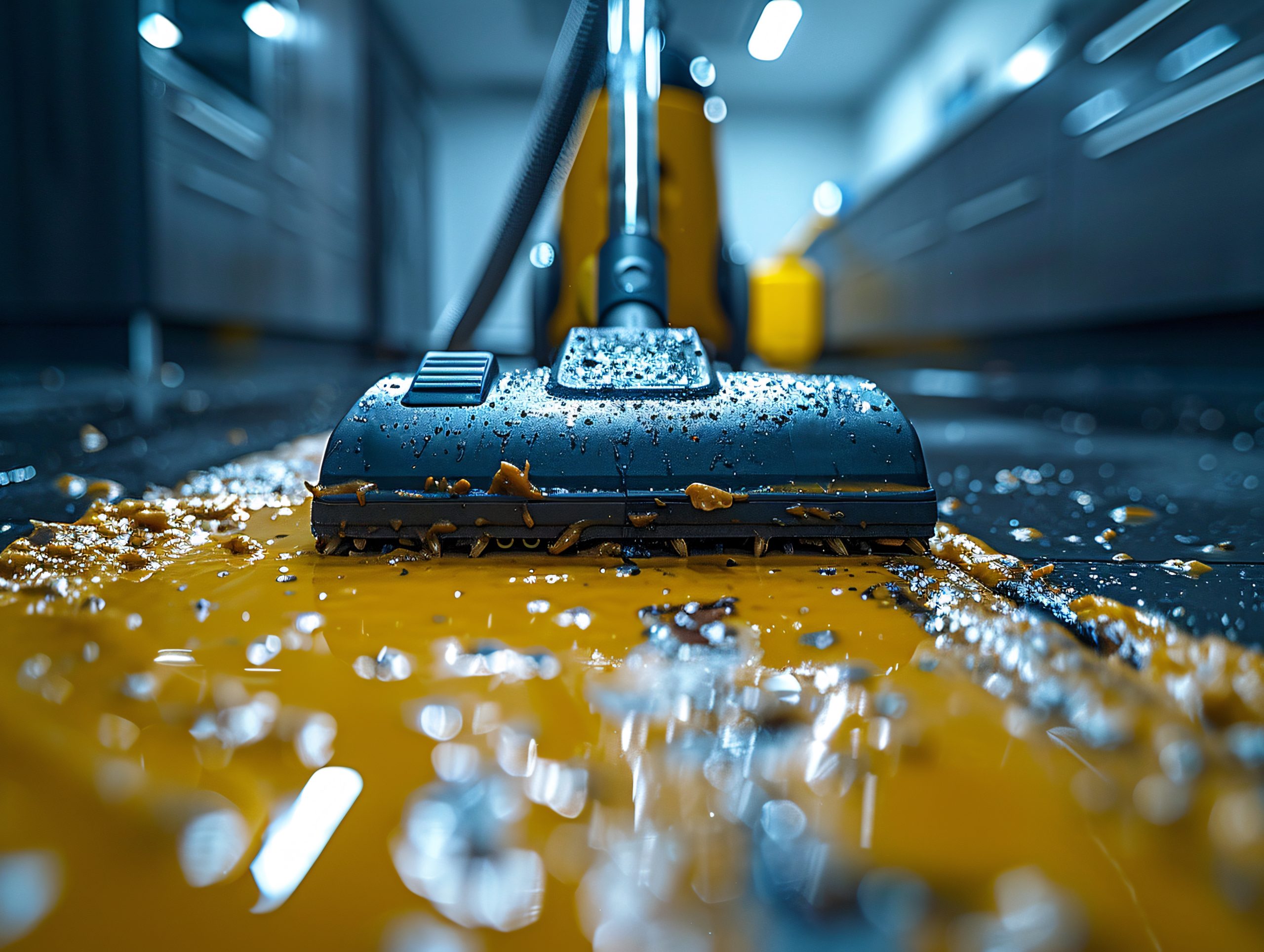
Industrial cleaning is not one discipline. A crew that is excellent in a logistics warehouse may be genuinely unsafe in a pharmaceutical clean room.
Sector experience worth verifying:
- Petrochemical and process plants, including Jurong Island site access and clearance procedures
- Pharmaceutical and life sciences laboratories, where cross-contamination protocols govern everything
- Food manufacturing, where sanitation standards are audited rather than assumed
- Electronics, where ESD-safe equipment is mandatory
- Heavy manufacturing, where the constraint is usually machinery access and lockout procedure
Ask for two named reference sites in your sector, and call them. A provider with genuine track record will offer references before you ask.
4. What is your emergency response time, and is it contractual?
Every provider says they respond quickly. Ask them to put a number in the contract.
The stronger operators in Singapore commit to deployment within two to four hours for industrial emergencies, with genuine round-the-clock availability rather than an answering service. Peniel Cleaning guarantees 2-hour deployment on a 24/7 basis islandwide, including Jurong Island, where dedicated teams remove the mobilisation delay that catches out providers arranging site clearance from scratch.
The follow-up question matters more than the first one: what happens if you miss it? A response guarantee with no consequence attached is a marketing line.
5. What insurance do you carry?
For industrial scopes, public liability coverage of $10 million or more is the sensible benchmark. Work injury compensation is mandatory. Professional indemnity is worth having.
Ask for the certificate of insurance and check the expiry date. Also check whether the coverage actually extends to the work being done — some policies carve out confined space entry or working at height, which is precisely the work you are buying.
6. Who is actually deployed, and are they employed by you?
This question separates contractors from labour brokers.
If the cleaners on your site are subcontracted, the training records, safety briefings and insurance cover may belong to a company you have never assessed. Ask whether staff are directly employed, whether they are WSQ-certified for the scope, and whether the same named crew returns each visit.
Continuity is underrated in industrial settings. A crew that knows where the isolation valves are, and which floor coating cannot take a particular solvent, works faster and breaks less.
7. What equipment do you bring, and is it right for my environment?
Industrial cleaning is equipment-led work. Ask what arrives on site:
- Automated floor scrubbers sized for your floor area rather than a domestic machine run for longer
- High-reach cleaning systems for structural steel, ducting and overhead services
- MOM-compliant confined space entry equipment, with certified entrants and standby personnel
- Explosion-proof equipment for ATEX-classified zones
- ESD-safe equipment for electronics environments
- ATP verification testing where cleanliness has to be demonstrated rather than asserted
ATP testing deserves a specific mention. It produces a documented result rather than a visual opinion, which is what an auditor wants to see. Ask whether it is included as standard or quoted as an extra — the answer tells you how the provider thinks about verification.
8. How do you price, and what is excluded?
Industrial cleaning in Singapore is normally quoted per square metre. Across the market, routine maintenance cleaning runs roughly $0.80 to $2.50 per sqm, and specialised industrial deep cleaning for petrochemical or pharmaceutical facilities ranges from about $3.00 to $8.00 per sqm.
The number itself is less revealing than the exclusions. Ask directly about:
- Equipment rental surcharges
- Chemical disposal fees
- Weekend, public holiday and night shift premiums
- Confined space entry charges
- Standby time when your plant runs behind schedule
These can add thirty percent or more to a quote that looked competitive on the headline rate. A provider that volunteers them before you ask is telling you something useful about how the rest of the relationship will go.
9. What happens during a plant shutdown?
Shutdown cleaning is where industrial providers separate most visibly. The work is compressed, sequenced against other trades, and every hour of overrun costs production.
Ask whether shutdown protocols are developed for your facility or applied from a template. Ask how they sequence around mechanical and electrical contractors. Ask what their contingency is when a preceding trade runs late — because one of them will.
A provider who has genuinely done this will answer in specifics: crew sizes, shift patterns, staging areas, waste routes. A provider who has not will answer in adjectives.
10. What does your contract commit you to, and how do I exit?
Contract terms in the Singapore market typically run from 3 to 36 months, and annual commitments usually deliver a 15 to 25 percent saving against ad-hoc engagement. That trade is normally worth making, provided the exit is clean.
Check the termination notice period. Fourteen days’ written notice is reasonable and is what the better operators offer. Long lock-ins with punitive exit terms are a sign that the provider expects you to want to leave.
Also ask what is inside the rate. On a properly structured corporate contract, cleaner salary, CPF, medical insurance, public liability cover, relief and replacement cleaners, training and supervisory inspection all sit within the quoted figure — which means you carry no employment or liability exposure for the staff deployed on your site.
A Simple Way to Score the Answers
Ten questions produce a lot of information and not much clarity unless you weight them. A workable scoring framework for industrial scopes:
- Safety certifications and compliance record — 30 percent
- Relevant sector experience — 25 percent
- Emergency response capability — 20 percent
- Cost transparency — 15 percent
- Equipment and technology — 10 percent
Score each provider from 1 to 5 against each criterion, apply the weightings, and compare totals. It takes twenty minutes and produces a defensible basis for the decision when procurement asks why you chose who you chose. If you want to compare providers in more detail, our 2026 provider comparison guide walks through the same criteria applied to plant cleaning specifically.
The weighting is deliberate. Cost sits fourth because in industrial environments the expensive outcome is almost never the invoice.
Where Peniel Cleaning Sits Against These Questions
For transparency, here is how we answer our own list.
Peniel Cleaning has operated in Singapore since 2007, is NEA licensed, holds bizSAFE Level 4 certification, and employs over 250 staff serving more than 200 corporate clients. Sector experience covers petrochemical and process plants, pharmaceutical and life sciences laboratories, food manufacturing, electronics, heavy manufacturing and logistics.
Emergency response is 24/7 with a contractual 2-hour deployment guarantee islandwide, supported by dedicated Jurong Island teams. Equipment includes automated scrubbers, high-reach systems and MOM-compliant confined space entry gear, with ATP verification testing available as standard on applicable scopes rather than quoted as an add-on.
Pricing follows a transparent per-square-metre model with contract terms from 3 to 36 months and 14 days’ written termination notice. Corporate contract rates are all-inclusive of cleaner salary, CPF, medical insurance, public liability insurance, relief and replacement cleaners, training and supervision.
Whether or not you end up working with us, ask the ten questions of everyone on your shortlist. The answers will narrow it quickly.
Frequently Asked Questions
What certifications should an industrial cleaning company in Singapore have?
Every cleaning business must hold a valid NEA Cleaning Business Licence. Licences are issued in three classes, and only Class 1 requires bizSAFE Level 3 certification, $250,000 paid-up capital and a clean compliance history — which makes Class 1 the meaningful signal for industrial work. bizSAFE Level 4 is a further step up. Confined space work additionally requires MOM-approved entry certification, and cleaning staff should hold WSQ certification for the scope performed.
How much does industrial cleaning cost in Singapore?
Across the Singapore market, routine industrial maintenance cleaning typically runs $0.80 to $2.50 per square metre, and specialised industrial deep cleaning ranges from $3.00 to $8.00 per square metre. Final pricing depends on facility type, contamination level, access conditions, and whether confined space entry or ATP verification testing is required.
What is the difference between commercial cleaning and industrial cleaning?
Commercial cleaning covers offices, retail units and similar premises, and is largely about presentation and hygiene. Industrial cleaning covers factories, plants and warehouses, and is a safety and compliance discipline involving hazardous materials, confined spaces, specialised equipment and regulatory documentation. The certification, insurance and equipment requirements are materially different.
How quickly should an industrial cleaning company respond to an emergency?
The stronger providers commit to deployment within two to four hours with genuine 24/7 availability. Ask for the response time to be written into the contract, and ask what remedy applies if it is missed.
Can industrial cleaning be done while the plant is running?
Routine maintenance cleaning can usually be scheduled around production shifts. Deep cleaning, decontamination and confined space work typically require partial or full shutdown. An experienced provider will design the schedule to minimise production downtime rather than simply asking for access.
What insurance should an industrial cleaning contractor carry?
Public liability coverage of at least $10 million, work injury compensation, and ideally professional indemnity. Check that the policy explicitly covers the scope being performed, since some policies exclude confined space entry or work at height.
Get an Industrial Cleaning Quote
Peniel Cleaning provides industrial cleaning services for factories, plants and warehouses across Singapore, including dedicated Jurong Island coverage and 24/7 emergency response with a 2-hour deployment guarantee.
For a free site survey and a written quotation within 1–2 business days, get in touch, call +65 6542 8850, or email enquiry@penielcleaning.com.sg.
